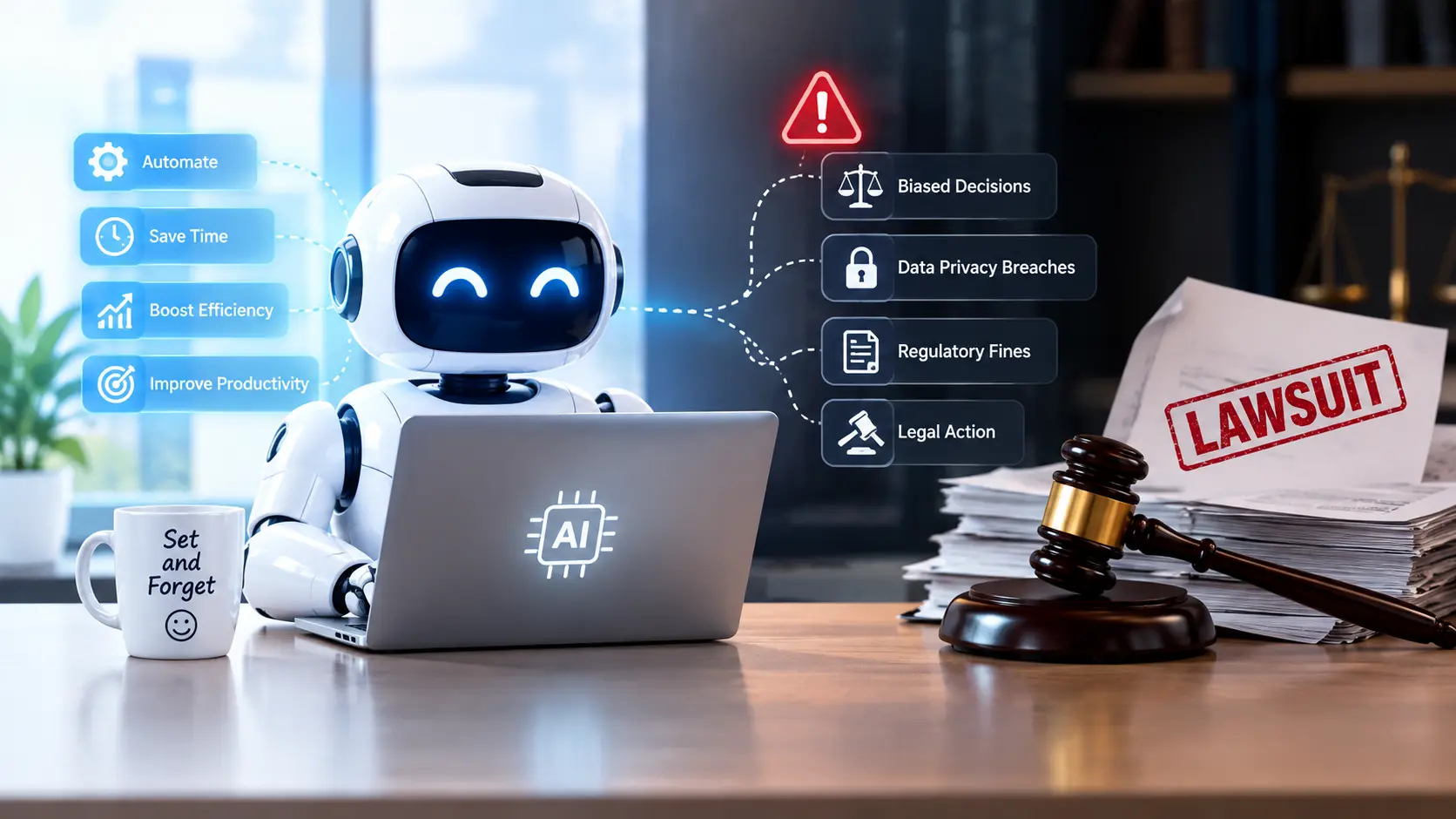
Robot typing on an AI laptop beside Automate, Save Time icons and Lawsuit legal risk warnings
Back To Blog Listing
Business GrowthAnalysis

The Real Cost of Unmonitored AI: Why 'Set and Forget' Automation Gets You Sued

Bharat Prajapati, Team Lead at InvesQ Tech SolutionsBharat PrajapatiTeam Lead · Sep 14, 2026 · 8 min read

The automation is currently running, and you are not observing it. That's the problem.

01The Automation Is Running — You Are Not Watching

Australian businesses use AI and automation tools just as confidently as they once would have hired a staff member and handed them the keys. You set it up, make one adjustment, and then go on to deal with the next crisis.

However, unlike a person, AI does not alter its behaviour in response to ethical considerations, company culture, or changes in the law. It simply works to optimise the particular metric you instructed it to optimise for — that's all.

That's when the lawsuits begin.

02Why "Set and Forget" Automation Breaks Businesses

The expression "set and forget" seems efficient and gives the impression of progress. In fact, it is merely negligence disguised as technology.

In practice, the situation is this: a company introduces an AI tool to deal with hiring decisions, customer service chatbots, or loan assessments. It works well at first, with accuracy appearing to be satisfactory and the cost per transaction falling. As a result, the team dismisses the matter.

Six months go by, and nobody looks at the logs, nobody carries out tests to check for bias, and no one confirms that the tool is still complying with company policy or, more crucially, with the law.

A customer then files a complaint on the grounds of discrimination. Or an employee takes legal action for wrongful dismissal because of an AI recommendation which had never been audited. Or a regulator observes that your automation tool has been making decisions in violation of consumer protection laws.

You are currently having to pay for lawyers. You are now having to tell your clients why your 'efficient' system has undermined their trust. You are now liable to pay fines or settlement costs that exceed the amount you managed to save by not keeping an eye on the tool.

It's not just a possibility — the Fair Work Commission in Australia has already dealt with cases in which automated systems had made decisions that affected employees' rights. The Australian Information Commissioner has produced guidance regarding AI and privacy, and further cases are expected.

03The Real Costs Hide in Three Places

Regulatory exposure. Australia still does not possess a single AI Act as the EU has. However, the regulators are not delaying action. The ACCC has laid out its expectations regarding the enforcement of AI. The OAIC regards AI in the same way as any other automated decision system — requiring accountability, transparency, and human oversight.

Whenever your automation tool is making decisions on matters such as credit, employment, access to health services, or customer service, there will be someone keeping an eye on the situation. That person doesn't necessarily need to be monitoring your compliance, but will be looking for complaints. When complaints are received, an investigation is initiated, and such investigations involve a financial cost.

An unmonitored system that violates these principles can attract fines up to AUD $50 million or 10% of turnover (ACCC enforcement), privacy breach notifications (OAIC), reputational harm from media coverage of unfair or biased decisions, and class action lawsuits if the harm affects multiple customers.

Liability arising from biased outcomes. AI systems do not pick up fairness naturally through osmosis; instead, they learn patterns from data. If the data contains historical bias, the system will reinforce that bias. A hiring tool that is trained on past recruitment data will discriminate against candidates from underrepresented groups, and a credit assessment tool based on lending history will disadvantage certain demographics.

You won't realise that this is taking place unless someone makes a complaint or a journalist carries out an investigation.

The Australian courts have now started to take automated bias seriously, with judges asking whether an audit of the tool was carried out, whether tests for bias were conducted, and whether there were any human review processes. If the answer to all three of these questions is no, then the liability falls heavily on the company.

Compliance drift. Laws are constantly changing, your business is constantly changing, and so are customer expectations; your automation tool only adjusts when you instruct it to.

A chatbot which has been trained using the customer service policies of 2023 could provide wrong advice in 2024 should your product terms have changed. An automation tool designed to comply with GDPR requirements might fail to meet the amendments to Australia's Privacy Act. A workflow that was in line with the requirements two years ago might now breach current consumer protection guidelines.

Monitoring involves carrying out scheduled audits — this includes testing the outputs, checking for any drift, and verifying that they remain in line with the current policy. Without it, you have a compliance debt that keeps on growing.

$50M

ACCC fine exposure

Or up to 10% of turnover

OAIC

Privacy accountability

Transparency + human oversight required

3

Liability questions

Audit, bias tests, human review

04What Monitoring Actually Looks Like

What I'm suggesting is not the idea of employing someone to monitor your systems around the clock; it's something that is systematic and achievable.

It's not a heavy burden; it's simply good risk management — and it's less expensive than going to court.

Practical monitoring practices

  1. 01

    Scheduled audits

    Monthly or quarterly, pull sample outputs from your automation system and review them for accuracy, bias, and policy compliance. A sample of 100 transactions takes a few hours to review properly.

  2. 02

    Bias testing

    Run the same input (with different demographic markers) through your system and compare outputs. If a resume passes for John but not Jamal, you have a problem. These tests take days to run once, then hours quarterly.

  3. 03

    Decision logs

    Keep records of what your system decided and why. When a complaint arrives, you need evidence you made reasonable decisions. Decision logs also show patterns: if 95% of credit rejections are in one postcode, that's a monitoring flag.

  4. 04

    Human review gates

    For high-impact decisions (hiring, credit, termination recommendations), require a human to review and approve before the decision is final. This breaks the "set and forget" cycle and creates accountability.

  5. 05

    Vendor accountability

    If you're using a third-party AI tool or SaaS platform, demand monitoring data and audit rights in your contract. You're liable for decisions the tool makes on your behalf, even if you didn't build it.

05The Compliance Structure That Works

If you're serious about keeping unmonitored AI out of your business, arrange it like this. You don't need to know about AI to use this system. You need discipline.

Four layers of oversight

  1. 01

    Governance layer

    Assign someone (or a team) to own AI compliance. They're not responsible for the tool's performance; they're responsible for its behaviour. They review audit findings. They approve policy changes to the automation logic.

  2. 02

    Documentation layer

    Document what the system is supposed to do, how you validated it, and how often you review it. This is your defence in a complaint or audit. "We did this thing on this date because X" beats "we didn't know it was biased."

  3. 03

    Testing layer

    Run quarterly audits, bias tests, and output reviews. Track results. If you find a problem, document the fix and when it was applied.

  4. 04

    Escalation layer

    If monitoring reveals bias, drift, or policy violations, you need a clear path to escalate, decide, and implement changes. A flag that sits in someone's inbox for three months isn't compliance.

06Where Australian Businesses Get This Wrong

Common assumptions that create risk

Wrong

Our AI vendor takes care of compliance.

No. Your vendor ensures their tool works as specified. You ensure it doesn't harm your customers, violate regulations, or expose you to liability. The vendor's responsibility and your responsibility are different.

Wrong

We'll check it if a problem comes up.

By then, it's too late. Complaints, investigations, and media coverage have already happened. Proactive audits catch problems before they become incidents.

Wrong

Our tool is only carrying out optimisation, not making decisions.

All the processes involved in classifying, ranking, filtering, and making recommendations involve real consequences. When an algorithm filters job applicants, it is making a decision about hiring. When one ranks loan applications, it is making a credit decision. Anytime an algorithm has an effect on someone's outcomes, it is acting as a decision-maker and therefore has to be kept under observation.

07What This Means for Your Business

You are at risk if you've used automation or AI tools without putting in place a monitoring system — not because you intended to be careless, but because it's the standard practice in the industry for people to set things and then forget them, and customs generally show risk rather than safety.

The answer is not to stop using your automation; it is to introduce oversight.

A structured compliance audit of your automation systems will tell you which tools carry regulatory risk, what monitoring gaps exist right now, which documentation you need to build, which decisions need human review gates, and how to fix drift and bias before they become complaints.

The cost comes as a big expense if you find out about serious issues, but it's a lot cheaper if you spot them yourself on your own schedule with a plan to fix them.

It merits discussion if you're using AI automation in relation to hiring, customer decisions, or service delivery and you haven't carried out an audit of the system in the past year (or at any time).

08How InvesQ Helps Australian Businesses

InvesQ Tech Solutions offers AI compliance audits specifically designed for Australian businesses. We review your automation systems, test for bias and drift, audit governance frameworks, and help you build monitoring processes that actually catch problems.

Not because compliance is trendy. Because getting sued costs more than preventing the suit.

Your automation should work harder, not expose you more.

Book a technical consultation to assess your automation risk and monitoring gaps.

09Key Takeaways

"Set and forget" automation is negligence disguised as efficiency — unmonitored AI creates regulatory, bias, and compliance-drift exposure.

Australian regulators (ACCC, OAIC, Fair Work) already expect accountability, transparency, and human oversight for automated decisions.

Practical monitoring — scheduled audits, bias testing, decision logs, human review gates, and vendor accountability — is cheaper than litigation.

Governance, documentation, testing, and escalation layers turn oversight into a repeatable operating system, not a one-off project.

Bharat Prajapati, Team Lead at InvesQ Tech Solutions

Bharat Prajapati

Team Lead, InvesQ Tech Solutions

Helping Australian businesses build automation that stays accountable — with governance, monitoring, and compliance built into the architecture.

Ready for a Brand That Matches the Business Behind It?

Schedule a technical consultation with InvesQ leads to evaluate your project, discuss scoping, and chart a clear path to execution.

Book a Consultation